01 Baby Gates & Stair Safety Best picks
Best banister guards: closing the railing gap a gate was never going to fix
A gate stops a child using the stairs. It does nothing about the four-inch gaps running the length of the railing beside them, or the landing rail a toddler can post a leg through. That is a different product, and there are four of them worth buying.
- By
- Mike M.
- Updated
- Method
- How we choose

We earn a commission if you buy through our links, at no extra cost to you. It never decides the ranking: the method is published. Affiliate disclosure
Quick picks
The short answer
| # | Product | Best for | Score | Price |
|---|---|---|---|---|
| 01 | 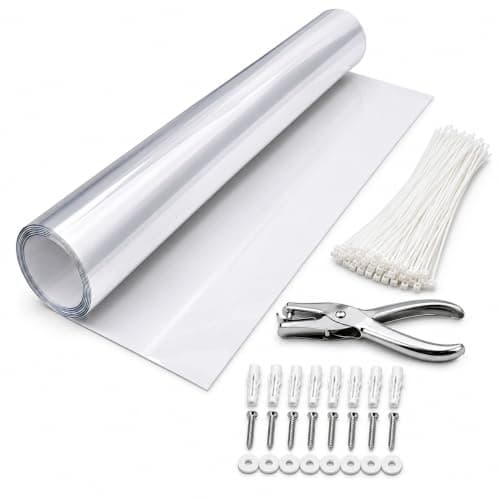 Cardinal Gates KS15 Clear Banister Shield (15 ft x 33 in) A 15-mil crystal-clear PETG sheet, 33 inches high, in four roll lengths from 5 to 50 feet. It is the only product in this category whose maker tells you how thick the material is, and a solid sheet is the only version of this product with no foot-holes in it. The trade is the install: you punch every hole yourself. | Best overall: the only one that publishes a thickness | 9.3 / 10 | Check price on Amazon |
| 02 | 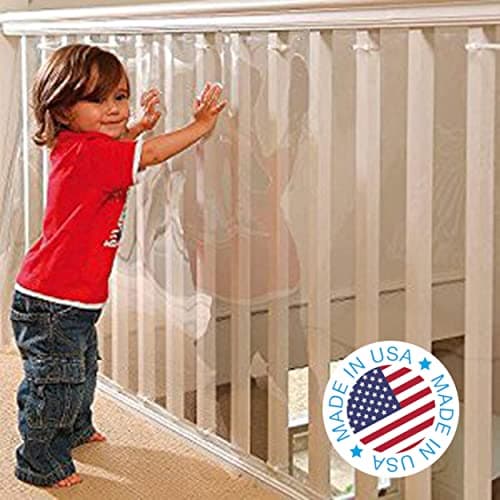 KidKusion Banister Guard (15 ft x 33 in) The same solid-sheet approach, 33 inches high, and the only clear guard here with a published UV treatment and a cold rating - minus 40 Celsius. That makes it the defensible choice on a porch or a deck rail you can see through. It stops at 15 feet, and KidKusion publishes no thickness. | Best for an outdoor or sunlit railing | 9.2 / 10 | $36.84Amazon |
| 03 |  Cardinal Gates DS15 Deck Shield Outdoor Safety Netting (15 ft x 36 in) Half-inch mesh netting, UV-protected, in rolls up to 50 feet - the only product here that covers a whole deck without a seam, and the lowest cost per foot. It publishes the one number that decides whether a net works. Black netting is also the most visible thing on this page. | Best for a long run and the cheapest per foot | 9.2 / 10 | $29.95Amazon |
| 04 | 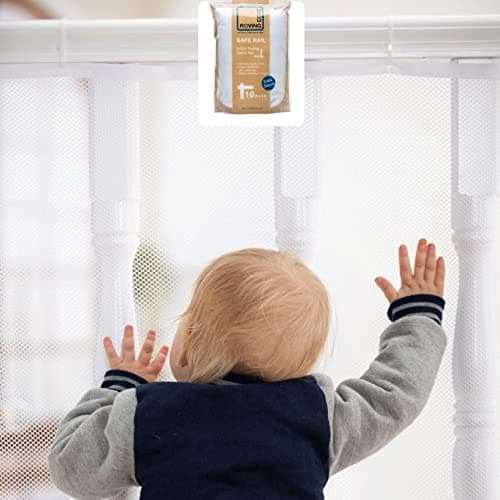 Roving Cove Stair Banister Guard (10 ft x 3 ft) Ten feet of see-through fabric mesh with releasable cable ties and 3M-taped mounts for the bottom edge, at the lowest ticket price in the group. It is the fastest install here by a distance. It publishes no mesh opening size, and fabric stretches, so plan on re-tensioning it. | Best cheap fix for one short run | 9.1 / 10 | $22.69Amazon |
#ad · Prices come live from Amazon, last checked November 5, 2026. Scores are ours, on our published 8.4-9.8 recommendation scale, compiled from standards statements, manuals and specs. Nothing below 8.4 is listed. Tap a row for the full write-up.
The 4-inch rule, and why your railing fails it
This category exists because of a number. Residential railing code, as published in IRC R312.1.3, requires that a guard on a walking surface or landing not allow a 4-inch sphere to pass through it, with a slightly looser 4 3/8-inch allowance for the triangular infill on a stair run. Four inches is not an arbitrary figure: it is roughly the size at which a small child's head will not fit through an opening their body can.
Two things follow from that, and they are the reason people end up on a page like this.
The first is that the rule applies to railings as built. If your house predates the current code, or the deck was built by a previous owner, or somebody replaced the spindles with something decorative, the gaps can be five or six inches wide and nothing about that is unusual. Measure before you assume. A tape measure across two adjacent spindles takes four seconds and tells you whether you need any product at all.
The second is subtler and catches careful parents out: a code-compliant railing can still be the thing that hurts a child. Four inches is wide enough for a leg, an arm and a determined toddler's shoulder. A child who posts a leg through a landing rail and then stands up has their knee trapped at one height and their weight at another. And on a landing above a stairwell, a gap that will not pass a head will still pass everything a child drops through it onto the flight below.
The injury numbers behind all of this are not small. Research from Nationwide Children's Hospital, published in 2012, found more than 93,000 children under five treated in US emergency departments every year for stair-related injuries, with the head or neck involved in 76 percent of cases. A railing guard does not address most of those - a gate does - but it addresses the specific subset where the child did not fall down the stairs at all. They went through the side of them.
Which is the honest framing for this whole page. A banister guard is a supplement to a gate, not an alternative to one. If you have not sorted the gate yet, start with best baby gates for stairs and come back.
How we ranked these
We do not test products. Every figure on this page comes from a manufacturer page or a named retailer listing, linked from the spec table on each pick, and the scores are editorial judgments compiled from that published data - the method is on how we choose.
For this category we weighted installation truth and toddler resistance at 25 percent each. That is deliberate, and it is because of what we found while putting the registry together: a banister guard is not a mechanism. There is nothing to latch, nothing to spring, nothing to defeat. A guard fails in exactly two ways, and both of them are install problems. Either the bottom edge was never properly fastened and a crawler lifted it, or the ties were spaced too far apart and the sheet bowed into a gap wide enough to matter.
Reversibility takes 15 percent, because this is a product a lot of people are putting on a railing they do not own, and value 15, because the cost of this job scales with the length of your railing rather than the price on the box.
Standards take only 10 percent, and they take it reluctantly. Not one product in this category states a safety standard. There is no ASTM specification for a railing guard the way there is ASTM F1004 for gates or ASTM F2090 for window guards. Every single pick scores near zero on that metric, which makes it a metric nobody can win on, and we will not pretend otherwise by weighting it at 25 percent like we do on a gate page. What you are buying here is a piece of plastic or netting and a bag of zip ties, judged on what the maker is willing to publish about it.
Sheet or mesh: the only real decision
Four products, two designs. Everything else is length, price and color.
A solid sheet - the Cardinal KS15 and the KidKusion guard - is a continuous roll of clear plastic with no openings in it at all. Nothing passes through: not a leg, not an arm, not a hard toy kicked at it from the landing side. It is also the better-looking option indoors, because clear plastic against painted spindles reads as a smudge rather than a fence. The downsides are real though. It shows every fingerprint and the dust that settles on the top edge. And it is the slower install, because you make every fastening hole yourself with the punch in the box.
Mesh - the Cardinal DS15 netting and the Roving Cove fabric net - breathes, goes up faster, costs less per foot, and in the DS15's case comes in rolls long enough to do an entire deck without joining two pieces. The trade is the one thing nobody mentions on a product listing: a half-inch square is small for a hand and about the right size for the toe of a toddler's shoe. Netting is marginally climbable in a way a smooth sheet is not. On a deck rail at 36 inches that is worth thinking about; on a landing rail beside a stairwell it is worth thinking about hard.
Read the Certification row across all four and you have the state of this category in one line. Read the Material row and you have the reason the Cardinal shield wins: it is the only one of the four that tells you how thick the stuff is.
The two measurements that decide it
More of these get returned over fit than over quality. Two numbers, taken before you order.
Total run length, including the bits you forgot. Walk the railing with a tape and add up every section you intend to cover: the stair run, the landing above it, and the short return section at the top that people consistently leave off and then discover is the widest gap in the house. Then add about 10 percent, because you lose length at the newel posts where the material has to wrap. If that total comes out over 15 feet, the KidKusion is out - its longest roll is 15 feet, and joining two rolls mid-span puts a seam exactly where a child will push. The Cardinal shield goes to 50 feet and the DS15 netting goes to 50 feet.
Railing height, measured from the floor to the underside of the handrail. This is the one that decides whether the guard covers the gap or leaves a strip of it open at the top. Both clear sheets here are 33 inches high. The DS15 netting comes in 36 inches and 29 inches - two different products, and ordering the short one for a 36-inch deck rail leaves a seven-inch band of open railing at eye level. The Roving Cove is 3 feet.
Cover the gap, not the railing. You are not trying to reach the handrail; you are trying to close the space between the bottom rail and wherever a child can no longer get a limb through. On most staircases that is the bottom 30-ish inches, which is why the whole category clusters around 33.
The install nobody warns you about
Every listing in this category says some version of "easy installation, no tools required." That is true in the sense that you will not need a drill. It is misleading about the time.
The clear sheets ship with a hole punch, and the reason they ship with a hole punch is that the roll has no holes in it. You hold the sheet against the inside face of the balusters, punch a hole beside each spindle, feed a zip tie through, and repeat. On a typical flight with spindles every four inches, that is forty-odd punches and forty-odd ties. It is not hard, but it is an afternoon with a sore thumb, and it is the single most common complaint about an otherwise good product.
Three more things worth knowing before you start. Work top-down, so gravity holds the roll against the rails while you punch. Leave the ties slightly loose until the whole run is up, then go back and tighten - a sheet pulled tight at one end will not reach at the other. And trim the zip-tie tails flush with flush-cutters rather than scissors, because a cut tie tail is sharp and it is at exactly the height of a face.
If you are doing this in a rental, all four are reversible: ties cut off, mounts peel, nothing drills. The adhesive mounts are the only part that leaves a mark, and that is on paintwork rather than through it. The broader renter-friendly playbook is on babyproofing an apartment or rental.
What a railing guard does not do
It does not stop a climber. This is the thing to be clear-eyed about, because a guard that closes every gap in the railing also presents a continuous surface, and a toddler who was previously defeated by the spindles now has something to lean a chest against while they get a knee up. Netting makes this easier than sheet does. Neither makes it impossible.
It does not make a railing structurally sound. If the newel post wobbles, or a spindle is loose in its socket, cable-tying thirty feet of plastic to it does not fix that and may load it further. Fix the railing first.
It does not substitute for the gate. A guard closes the sides of a staircase; a gate closes the ends of it. The two jobs are not interchangeable, and a pressure-mounted gate is still never the right answer at the top of a flight.
And it does not do anything about the handrail itself, the things stored on the landing, or the gap between the bottom stair and the wall. The full sweep of a staircase - the gate, the gaps, the treads, the lighting and the stuff on the steps - is on babyproofing stairs and hallways.
Which one for which railing
Indoor staircase, spindles, a run under 50 feet: the Cardinal KS15 Banister Shield. Solid sheet, published thickness, clear enough that the staircase still looks like a staircase, and the only line here that scales from a 5-foot landing return to a 50-foot roll.
Porch, deck or a sunlit stairwell, and you want to see through it: the KidKusion Banister Guard. It is the only clear product here with a published UV treatment and a cold rating, and on a railing that takes weather that is the spec that decides it. Confirm your run is 15 feet or under.
A whole deck, a balcony, or the cheapest route per foot: the Cardinal DS15 Deck Shield. Half-inch mesh, published, 50-foot rolls, weather-rated. Accept that it looks like netting, and read babyproofing an apartment balcony first if the railing in question is five floors up, because on a balcony the guard is only one of four jobs.
One short landing run, tonight, for the least money: the Roving Cove net. Releasable ties, mounts for the bottom edge, up in twenty minutes. It publishes the least of the four and the fabric stretches, so put a reminder in your phone to re-tension it in a month.
And if your gaps measure under four inches: buy none of them. Spend the money on the gate instead.
In detail
Every pick, in full
01
Best overall: the only one that publishes a thickness
Cardinal Gates KS15 Clear Banister Shield (15 ft x 33 in)
Our score
9.3 / 10Prevents
A 15-mil crystal-clear PETG sheet, 33 inches high, in four roll lengths from 5 to 50 feet. It is the only product in this category whose maker tells you how thick the material is, and a solid sheet is the only version of this product with no foot-holes in it. The trade is the install: you punch every hole yourself.
- Standards status
- No safety standard stated. A railing guard is not a gate, so ASTM F1004 and 16 CFR 1239 do not apply to it
- Installation truth
- It is a roll of sheet plastic with no pre-made holes: Cardinal Gates ships a hole punch and zip ties and you make every hole yourself, one beside each spindle, then trim the length with scissors. Budget an afternoon for a full flight. The bottom edge is the part people under-fasten, and an unfastened bottom edge is a flap a crawler goes under.
Published specs (tap for source)
Rubric sub-scores (0-10) and this page's weights
- Standards & certification (10%)
- 5
- Installation truth (25%)
- 8
- Toddler resistance (25%)
- 8
- Adult one-hand use (10%)
- 8
- Damage & reversibility (15%)
- 8
- Value (15%)
- 7
What it gets right
- A solid sheet, so nothing passes through it - not a leg, not an arm, not a toy
- Publishes a material and a thickness, which almost nothing else in this category does
- Clear, so it does not black out a staircase the way netting does
- Four roll lengths, so a short run does not mean buying 15 feet
What it doesn't
- You punch every hole yourself; this is the slowest install here
- Sheet plastic shows fingerprints and dust more than mesh does
- No standard stated, so there is nothing to check it against
- Scissors cut it to length, which means scissors cut it full stop - keep them away from an older child
Skip it if…
…your child already climbs the railing; a smooth sheet removes the foot-holes but it also gives them a solid wall to lean on, and nothing on this page stops a climber going over the top.
#ad · Price as of November 5, 2026 · Affiliate disclosure for the link to Cardinal Gates KS15 Clear Banister Shield (15 ft x 33 in)
02
Best for an outdoor or sunlit railing
KidKusion Banister Guard (15 ft x 33 in)
Our score
9.2 / 10Prevents
The same solid-sheet approach, 33 inches high, and the only clear guard here with a published UV treatment and a cold rating - minus 40 Celsius. That makes it the defensible choice on a porch or a deck rail you can see through. It stops at 15 feet, and KidKusion publishes no thickness.
- Standards status
- No safety standard stated on the maker page or the Amazon listing
- Installation truth
- Line the roll against the rails, punch a hole beside each vertical spindle with the included punch, feed a tie strap through, trim with scissors. KidKusion's own store is routinely sold out of both lengths, so confirm the listing you buy is the 15-foot roll and not the 10-foot one before you order a staircase's worth.
Published specs (tap for source)
Rubric sub-scores (0-10) and this page's weights
- Standards & certification (10%)
- 4
- Installation truth (25%)
- 8
- Toddler resistance (25%)
- 8
- Adult one-hand use (10%)
- 8
- Damage & reversibility (15%)
- 8
- Value (15%)
- 7
What it gets right
- Publishes a UV treatment and a cold rating, so it is the defensible choice outdoors
- A solid sheet, same as the Cardinal: no mesh squares to use as a foot-hole
- A 10 ft option for a short landing run
- Trims with household scissors
What it doesn't
- Does not publish a thickness, so you cannot compare rigidity with the Cardinal shield
- The maker's own store is frequently sold out; availability moves around
- Same hole-punching install, same afternoon
- No standard stated
Skip it if…
…your railing run is longer than 15 feet; there is no 30 or 50 foot roll in this line, and two rolls joined mid-span leave a seam at the exact place a child will push.
#ad · Price as of November 5, 2026 · Affiliate disclosure for the link to KidKusion Banister Guard (15 ft x 33 in)
03
Best for a long run and the cheapest per foot
Cardinal Gates DS15 Deck Shield Outdoor Safety Netting (15 ft x 36 in)
Our score
9.2 / 10Prevents
Half-inch mesh netting, UV-protected, in rolls up to 50 feet - the only product here that covers a whole deck without a seam, and the lowest cost per foot. It publishes the one number that decides whether a net works. Black netting is also the most visible thing on this page.
- Standards status
- No safety standard stated; this is netting, and no consumer standard covers it
- Installation truth
- Cable ties, included, through the mesh and around the rails - and the detail that matters outdoors is the bottom edge, because wind lifts an unfastened net and a gap at the deck boards is the gap a toddler uses. Mesh is also a ladder: half-inch squares are small for a hand but a shoe toe fits, so do not treat netting as a climbing deterrent.
Published specs (tap for source)
Rubric sub-scores (0-10) and this page's weights
- Standards & certification (10%)
- 4
- Installation truth (25%)
- 7
- Toddler resistance (25%)
- 7
- Adult one-hand use (10%)
- 8
- Damage & reversibility (15%)
- 9
- Value (15%)
- 9
What it gets right
- Publishes the mesh opening size - half an inch - which is the number that decides whether a net works
- Rolls up to 50 ft, so a whole deck goes up without a seam
- Weather and UV rated by the maker, unlike the indoor sheets
- The cheapest per foot in this group
What it doesn't
- Black netting is the most visible option here; it reads as a construction net on a nice deck
- Mesh gives a shoe toe something to stand on
- 36 in is the tall version, so measure your rail height before ordering the 29 in
- No standard stated
Skip it if…
…the railing is the indoor staircase in the middle of your living room; this is outdoor netting and it will look like it.
#ad · Price as of November 5, 2026 · Affiliate disclosure for the link to Cardinal Gates DS15 Deck Shield Outdoor Safety Netting (15 ft x 36 in)
04
Best cheap fix for one short run
Roving Cove Stair Banister Guard (10 ft x 3 ft)
Our score
9.1 / 10Prevents
Ten feet of see-through fabric mesh with releasable cable ties and 3M-taped mounts for the bottom edge, at the lowest ticket price in the group. It is the fastest install here by a distance. It publishes no mesh opening size, and fabric stretches, so plan on re-tensioning it.
- Standards status
- No standard stated; a railing net is not a gate and is not covered by ASTM F1004
- Installation truth
- Cable ties every few balusters, plus the 3M-taped mounts at the bottom so a crawler cannot lift the edge. It stops slipping between rails; it does nothing about climbing over them.
Published specs (tap for source)
Rubric sub-scores (0-10) and this page's weights
- Standards & certification (10%)
- 4
- Installation truth (25%)
- 8
- Toddler resistance (25%)
- 6
- Adult one-hand use (10%)
- 8
- Damage & reversibility (15%)
- 9
- Value (15%)
- 8
What it gets right
- Fixes baluster gaps over the 4 in limit
- No drilling
- Can be rolled back and trimmed to fit
- Indoor or deck
What it doesn't
- Does not stop climbing
- Cable ties are visible
- Needs re-tensioning as it stretches
Skip it if…
…your balusters are already under 4 in apart; the net adds nothing there.
#ad · Price as of November 5, 2026 · Affiliate disclosure for the link to Roving Cove Stair Banister Guard (10 ft x 3 ft)
What this job actually costs
Think in dollars per foot rather than dollars per box, because the box sizes are not comparable. At the manufacturer prices published on the pages linked above, the Cardinal shield's 15-foot roll and the KidKusion 15-foot roll land in the same mid-thirties-to-forty band, which is a little under three dollars a foot. The DS15 netting at 15 feet is the cheapest of the four per foot, and its 50-foot roll brings that down further. The Roving Cove has the lowest ticket price of all but covers only 10 feet, so per foot it is mid-pack.
Live prices move, and we do not print a number we cannot verify at the moment you read it - the buy buttons above carry whatever Amazon is charging today. The useful planning figure is that a single flight plus its landing is usually a one-roll job in the twenty-to-forty dollar bracket, and a wrap-around deck is a two-to-three-roll job. That is cheap relative to a gate, which is one reason this is a sensible thing to fix even when the gaps are only marginally too wide.
The ties are the consumable
Every product here ships with ties, and on every one of them the included count is sized for an average run rather than yours. A bag of releasable zip ties costs a few dollars and means you are not rationing fastenings two-thirds of the way up a flight - which is exactly how guards end up with twelve-inch gaps between ties and a bowed middle. Buy a bag.
Releasable ties are worth the small premium over the one-way kind, for two reasons: you will reposition the guard at least once while you learn how it hangs, and when the child outgrows it you take the whole thing off in ten minutes instead of cutting forty ties off a painted spindle with snips.
When to skip the product entirely
If the gap measures under four inches, there is nothing to close. If the railing is on a flight you have already gated at both ends and the child is never on the stairs unaccompanied, the guard is lower priority than most things on the babyproofing checklist. And if the hazard you are actually worried about is the child climbing the railing rather than going through it, no product on this page solves that - that is a supervision and a furniture-placement problem, and the honest answer is to move whatever they are climbing from.
One genuine alternative: if the railing is short and the real goal is to keep the child off the landing altogether, a second gate is often simpler and more effective than thirty feet of plastic. That calculation is in baby gates for banisters, which covers mounting a gate to a post without drilling it.
How we chose
How these picks were chosen
Every product currently sold for this job was read and compared, then scored against the exact problem this page is about: the manufacturer's published specs, the opening and fit charts, the safety standard it states, the install conditions in the manual, the warranty terms and the cited research. The sources are listed at the bottom of the page.
Scores come from that published data on a rubric you can read, a missing spec is scored neutral rather than guessed, and nobody pays for placement. The full rubric is on How We Choose.
- Standards & certification
- 10%
- Installation truth
- 25%
- Toddler resistance
- 25%
- Adult one-hand use
- 10%
- Damage & reversibility
- 15%
- Value
- 15%
The weights that ordered this page. Each product's score is published on our 8.4-9.8 recommendation scale and is the same wherever it appears.
FAQ
Questions people ask
How wide does a baluster gap have to be before I need a banister guard?
Is clear plastic sheeting better than a mesh net on a banister?
Do banister guards meet a safety standard?
Will a banister guard damage the railing or the paint?
How long does it take to install a banister guard?
Can I use a banister guard on a deck or balcony railing?
Does a banister guard stop a toddler climbing the railing?
Keep going
Related guides and picks
- Babyproofing stairs and hallwaysThe whole-staircase sweep: the gate, the gaps, the treads and what is stored on the steps.
- Baby gates for banistersThe other half of the railing problem: mounting a gate to a post without drilling it.
- Best baby gates for stairsFix the ends of the staircase before you fix the sides of it.
- Babyproofing an apartment balconyWhere the netting pick does its other job, and the three things it does not cover.
- How tall should a baby gate beThe height question, for the climber a railing guard will not stop.
Update log
What changed
- First published.
Receipts
Sources
- 01Viewrail railing-code reference: the 4-inch sphere rule, citing IRC R312.1.3 (guards on walking surfaces and landings must not pass a 4-inch sphere; stair guard infill is allowed 4 3/8 in) (checked Nov 5, 2026)
- 02Nationwide Children's Hospital Center for Injury Research and Policy, March 2012 (Pediatrics, April 2012): more than 93,000 children under 5 treated annually in US emergency departments for stair-related injuries, 1999-2008; head and neck injured in 76 percent of cases (checked Nov 5, 2026)
- 03CPSC: Business guidance for gates and enclosures, 16 CFR part 1239 / ASTM F1004 (accessed Sep 21, 2026)
- 04CPSC publication: Childproofing Your Home, 12 Safety Devices to Protect Your Children (accessed Sep 21, 2026)
Specs, standards statements and install requirements come from the manufacturer's own pages and manuals (or a named retailer's listing where the brand doesn't publish them); injury data and standards come from the CPSC, ASTM, NEC via ESFI and the AAP, linked above. Prices are set by Amazon and change often, so the buy button always takes you to the live listing. Read the full method.