06 Babyproofing by Room & Stage Best picks
Best medicine lock boxes: the one babyproofing job a cabinet latch does not finish
Medicines are the substances a toddler actually reaches, and they are rarely behind the latch you fitted under the sink. They are in a handbag, on a nightstand, in the kitchen drawer with the scissors. A box fixes that for about the price of two cabinet latches.
- By
- Mike M.
- Updated
- Method
- How we choose
We earn a commission if you buy through our links, at no extra cost to you. It never decides the ranking: the method is published. Affiliate disclosure
Quick picks
The short answer
| # | Product | Best for | Score | Price |
|---|---|---|---|---|
| 01 | 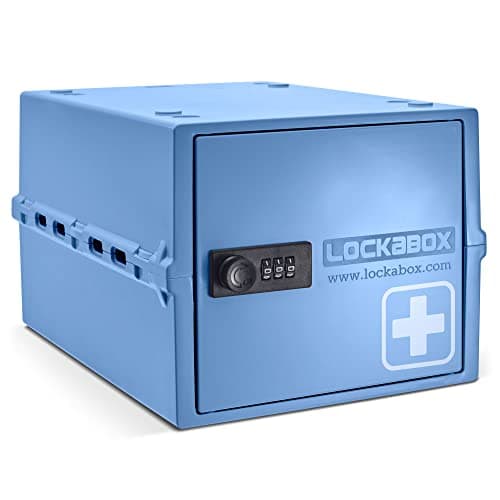 Lockabox One (10L medication lock box) A one-piece polycarbonate box with a 3-digit dial, published internal dimensions and a cold rating low enough for refrigerated medicines. Nothing to install, nothing to lose, and the clear version lets you see it is shut from across the kitchen. | Best overall: portable, keyless, and it fits the fridge | 9.1 / 10 | $39.95Amazon |
| 02 | 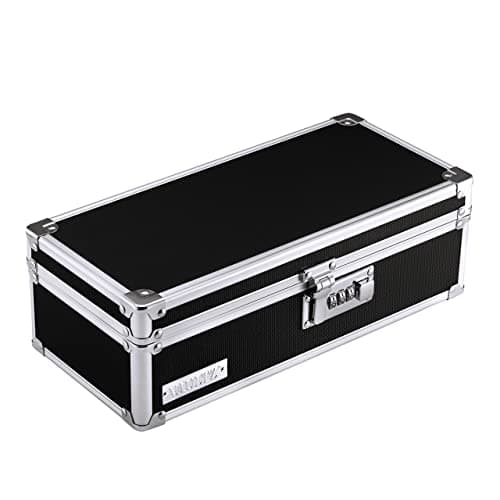 Vaultz Locking Medicine Storage Box (3.75 x 11.88 x 5.25 in) A flat case with a keyless combination and elastic dividers. At 3.75 inches deep it slides where a cube will not, which is usually the difference between a box you use and a box on top of the refrigerator. | Best for a shelf or a drawer | 9.1 / 10 | $34.99Amazon |
| 03 | 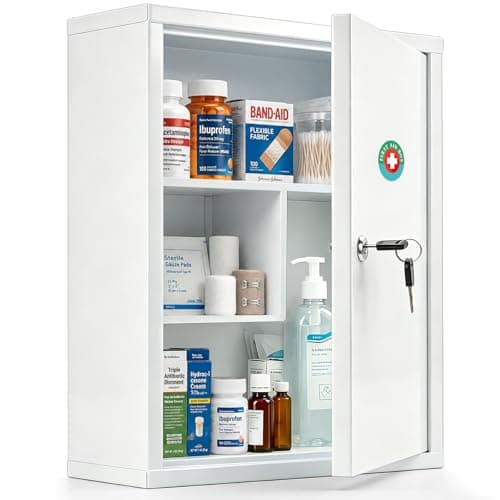 KYODOLED Locking Medicine Cabinet, Wall Mount (15.75 in) A steel wall cabinet with three compartments and a key. It is the only shape here that does both halves of the standard advice at once - out of reach and locked - and the only one a child cannot carry away. | Best permanent fix: up and locked | 8.7 / 10 | $39.99Amazon |
| 04 | 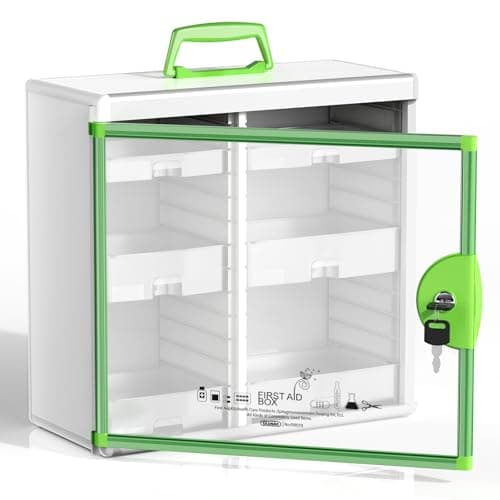 Glosen Lockable Medicine Cabinet (6 removable trays) Six removable trays in an aluminum cabinet that can hang on a wall or lift off by the handle. Buy it if you are running several prescriptions; skip it if you have three bottles and some infant acetaminophen. | Best for a lot of medicines | 8.7 / 10 | $62.09Amazon |
| 05 | 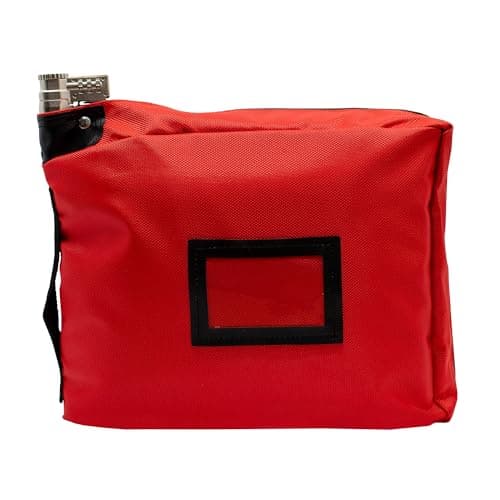 Cardinal Bag Supplies Large Combination Locking Medicine Bag A soft combination-locked bag for the week at a relative's house. The lock holds the zipper and the fabric holds nothing, so it is a delay and a signal rather than a container - which is still better than a wash bag on an open shelf. | Best for travel and visits | 8.7 / 10 | $26.99Amazon |
#ad · Prices come live from Amazon, last checked November 4, 2026. Scores are ours, on our published 8.4-9.8 recommendation scale, compiled from standards statements, manuals and specs. Nothing below 8.4 is listed. Tap a row for the full write-up.
What the exposure data actually says
Most babyproofing attention in a house goes to the cabinet under the kitchen sink, and it should: Poison Control's 2024 national data puts household cleaning substances at the top of the list for children five and under, 87,031 substances, 10.1 percent of the pediatric total. That is the single biggest category and it is the reason under-sink cabinet locks exist.
Then look at what comes next. Analgesics are second at 78,993 substances, 9.1 percent - that is painkillers, including the children's acetaminophen you keep within reach precisely because you need it at 2am. Dietary supplements, herbals and homeopathic products are at 59,575 (6.9 percent). Antihistamines are at 40,924 (4.7 percent) and plain vitamins at 40,343 (4.7 percent). Add the medicine-shaped categories together and they comfortably exceed the cleaners, out of a pediatric total of 851,928 substances for the year.
One more figure from the same data, and it is the one that should decide whether you buy anything: 99.2 percent of exposures in children under six are unintentional. Nobody in these numbers made a decision. A bag was left on a chair, a bottle was set down on a counter during a phone call, a grandparent's pill organizer was on the nightstand because that is where it lives.
That is the gap a medicine lock box fills, and it is a different gap from the one a cabinet latch fills. Cleaners stay in one place, so you can latch that place. Medicines move: handbag, car, nightstand, kitchen counter, diaper bag, back again. A latch on a cabinet does nothing for a bottle that spends its day in motion. A box gives the medicines one home, and the lock makes the home hold.
How we ranked these
We do not test products. Every figure on this page comes from a manufacturer page or a named retailer listing linked from the spec table of each pick, and the scores are editorial judgments compiled from that published data. The rubric is on how we choose.
Toddler resistance carries 35 percent here, more than our default, because this is a category where the difference between products is almost entirely how hard they are to defeat and how easy they are to carry off. Installation truth takes 15 percent, adult one-hand use 15 (you will open this holding a sick child), value 15, damage and reversibility 10, and standards 10 - every product here states no safety standard, because there is no consumer standard for a medicine lock box to meet, and a metric nobody can win on should not swing the ranking.
Worth saying plainly: none of these is a safe. One of them, Lockabox, puts it in writing on its own site - the products are not guaranteed to be secure or tamper-proof and are a deterrent against casual access. That is the honest frame for the whole category. These products buy you the thirty seconds and the extra step that an unintentional exposure needs in order not to happen.
Four shapes, four different households
The ranking above is a weighted score, but in practice the choice is a shape, and the shape follows from where your medicines currently live.
The portable hard box. A box you can carry, with no fixings. It is the right answer when the medicines have no fixed home - when some live in the kitchen, some in a bag, some in the fridge - and you want one place to put all of them tonight without finding a drill. The Lockabox version is the one that publishes its internal dimensions, which matters because the door aperture on it is 6.9 by 6 inches and a tall bottle has to go through that, not just into the box.
The flat case. Same idea, different footprint: a long shallow box designed to go on a shelf or in a drawer. The Vaultz case is 3.75 inches deep, which is the number to check against your bottles - pill bottles lie down in it, tall liquid bottles do not stand up. This is the shape to buy when there is already a logical spot and the only thing missing is a lock.
The wall cabinet. A steel or aluminum box with a key, screwed to the wall. It is the only one that cannot be carried away, and it is the only one that gets the medicines high as well as locked. The KYODOLED is the small, cheap version; the Glosen with six trays is the version for a household managing several prescriptions, and it can also be lifted off the wall, which is convenient and undoes the main advantage if you do it.
The soft bag. For travel. A combination lock on a zipper is a real deterrent against a curious toddler in an unfamiliar bedroom and no deterrent at all against anything sharper than that. It earns its place because the alternative, at a grandparent's house, is usually nothing - the same gap covered by a travel babyproofing kit.
| Spec | Lockabox One (10L medication lock box) | Vaultz Locking Medicine Storage Box (3.75 x 11.88 x 5.25 in) | KYODOLED Locking Medicine Cabinet, Wall Mount (15.75 in) | Glosen Lockable Medicine Cabinet (6 removable trays) |
|---|---|---|---|---|
| Size | 12.2 in x 8.3 in x 6.7 in (31 x 21 x 17 cm)11.1 in x 7.6 in x 6.3 in (28.3 x 19.2 x 16.1 cm) | 3.75 in x 11.88 in x 5.25 in | 15.75 in | 15.63 in x 6.5 in x 15.43 in |
| Material | Medical-grade polycarbonate; shatter-resistant | Not published | Steel construction | Aluminum frame |
| Closure | 3-digit combination lock, no key | Keyless 3-digit combination lock | Key lock, keys supplied | Key lock |
| Mount | None; free-standing, no fixings supplied | None; free-standing case | Wall mounted | Wall mounted or portable with a carry handle |
| Certification | Not published | Not published | Not published | Not published |
Up and locked: the height rule
The advice every poison center and the American Academy of Pediatrics gives is two-part, and people reliably do one half of it. Medicines go up and out of sight, and they go behind a lock. A locked box at knee height is a puzzle a toddler has all afternoon to work on. An unlocked shelf at head height is a step stool away from being floor height.
If you buy a portable box, you still have to decide where it goes, and the answer is a high shelf, not the kitchen counter. The counter is where it will actually end up, which is the honest argument for the wall cabinet: it cannot migrate. If you buy the wall cabinet, mount it above adult shoulder height. Mounted at the usual bathroom-cabinet height it is a box with a key in it, and the key is in a drawer twelve inches away.
One practical note for a two-story house. Medicines tend to end up wherever the adult who takes them sleeps, which is usually upstairs, while the children's medicines are downstairs near the kitchen. Two cheap boxes beat one good box in the wrong room, and this is the one category where we would rather you bought the second cheap one than upgraded the first.
Combination or key
Three of the five picks here use a 3-digit combination and two use keys, and the difference matters more than the price difference between them.
A combination has nothing to lose and nothing to leave out. It is also the one you will fumble at 2am with a feverish child on your hip, and a 3-digit dial is not a serious barrier to anybody older than about five. Set it to something that is not 000, not 123, and not a birthday a child can read off a birthday card.
A key is faster and harder to guess, and it creates a second object you have to keep away from the child. The failure mode is universal and boring: the key ends up on top of the cabinet, on a hook beside it, or in the unlocked drawer underneath. If you buy a key-locked cabinet, the key goes somewhere unrelated - a keyring in your pocket, a hook inside a different locked space - or the lock is decoration.
There is no third option in this category. Nothing here is biometric, nothing is a real safe, and the products that are real safes are not designed for someone reaching for an antihistamine at midnight.
What belongs in the box
Parents fill these with prescription bottles and stop. The exposure data says the box should be fuller than that, and the easiest way to think about it is: anything that looks like candy, anything in a bottle with a measuring cup, and anything you take daily.
The obvious ones. Prescriptions, children's liquid pain and fever medicine, adult painkillers in every form including the bottle in a handbag.
The ones that get missed. Vitamins and gummy supplements, which sit at 4.7 percent and 6.9 percent of pediatric exposures respectively and which are designed, in the gummy case, to be appealing to a child. Antihistamines, including the ones that come in a blister pack in a coat pocket. Iron tablets, which are far more dangerous to a toddler than their packaging suggests. Diaper creams and teething gels. Nicotine pouches and vape liquid. Cannabis edibles in any state where they are legal, which are the most candy-like thing in most houses.
The one people argue about. A grandparent's weekly pill organizer. It is the single most dangerous object in a visiting relative's bag - no child-resistant cap, seven open compartments and a transparent lid - and asking a guest to put it in a locked box feels rude. Ask anyway, or buy a second cheap box and hand it to them. The grandparents' babyproofing page covers the rest of that conversation.
What does not belong in the box: the poison center's phone number, which should be on the refrigerator and in your phone, not locked inside the thing you may be panicking about.
What does not work
The bathroom medicine cabinet. It is the wrong place for two reasons. It usually has no lock, and steam and heat are bad for medicines anyway. It is also the first place a four-year-old looks, because that is where they have watched you go.
A high shelf on its own. Height buys you about eighteen months. After that you have a climber, a dining chair and a countertop, and the standard advice is two-part for exactly this reason.
Child-resistant caps. They are a legal requirement on many medicines and a genuinely good layer, and the name means what it says: resistant, not proof. Testing protocols for these caps expect that some children will open them. They are the backstop for the day the box was left open, not the plan.
A cabinet latch on the cabinet where the medicines happen to be. This one is closer to working, and it is what a lot of houses do. The problem is that it only protects the medicines that are in that cabinet at that moment, which is never all of them. If you would rather go this route than buy a box, fit a magnetic lock rather than a spring latch and read best cabinet locks for babyproofing first.
Buying a box and leaving it open on the counter all day. The honest failure mode of this entire category. A box only works while it is shut, and a box that lives where you set it down is a box that is open. This is the strongest argument for the wall cabinet and the reason it ranks where it does despite the drilling.
In detail
Every pick, in full
01
Best overall: portable, keyless, and it fits the fridge
Lockabox One (10L medication lock box)
Our score
9.1 / 10Prevents
A one-piece polycarbonate box with a 3-digit dial, published internal dimensions and a cold rating low enough for refrigerated medicines. Nothing to install, nothing to lose, and the clear version lets you see it is shut from across the kitchen.
- Standards status
- No safety standard stated; Lockabox's own page says the products are not guaranteed to be secure or tamper-proof and are a deterrent against casual access
- Installation truth
- There is no install, which is the point and also the limit: a box with no fixings is a box an older child can carry off to work on in another room. The combination is the other thing to get right - it is a 3-digit dial, so set it to something that is not 000 and not a birthday, and do it before you put anything in. The internal space is 11.1 by 7.6 by 6.3 inches, but the door aperture is only 6.9 by 6 inches, so measure a tall bottle against the opening rather than against the box.
Published specs (tap for source)
Rubric sub-scores (0-10) and this page's weights
- Standards & certification (10%)
- 2
- Installation truth (15%)
- 9
- Toddler resistance (35%)
- 8
- Adult one-hand use (15%)
- 9
- Damage & reversibility (10%)
- 10
- Value (15%)
- 6
What it gets right
- No install and no key, so nothing to drill and nothing to lose
- Publishes internal dimensions and the door aperture, which almost nothing else here does
- Rated cold enough for refrigerated medicines
- Transparent versions let you confirm the lid is shut without opening it
What it doesn't
- The most expensive portable box here
- Its own maker says it is a deterrent, not a secure safe
- A clear box shows a child exactly what is inside
- Nothing holds it down, so it can be carried away
Skip it if…
…you want the medicines fixed in place; a box with no fixings travels, and that cuts both ways.
#ad · Price as of November 4, 2026 · Affiliate disclosure for the link to Lockabox One (10L medication lock box)
02
Best for a shelf or a drawer
Vaultz Locking Medicine Storage Box (3.75 x 11.88 x 5.25 in)
Our score
9.1 / 10Prevents
A flat case with a keyless combination and elastic dividers. At 3.75 inches deep it slides where a cube will not, which is usually the difference between a box you use and a box on top of the refrigerator.
- Standards status
- No safety standard stated on the listing
- Installation truth
- Nothing to install, and nothing to anchor it either. The shape is the deciding factor: at 3.75 inches deep it takes pill bottles lying down rather than standing up, so a tall liquid bottle is the thing that will not fit. The elastic dividers are what stop the contents collapsing into one pile, which matters more than it sounds when you are opening it at 3am.
Published specs (tap for source)
Rubric sub-scores (0-10) and this page's weights
- Standards & certification (10%)
- 2
- Installation truth (15%)
- 9
- Toddler resistance (35%)
- 7
- Adult one-hand use (15%)
- 8
- Damage & reversibility (10%)
- 10
- Value (15%)
- 8
What it gets right
- Keyless, so there is no key on a hook for a child to find
- Flat shape fits a shelf or a drawer where a cube will not
- External dimensions published, so you can check it against the shelf before ordering
- Dividers inside, which most boxes at this price skip
What it doesn't
- Only 3.75 inches deep, so tall bottles have to lie down
- Opaque, so you cannot confirm it is locked without trying it
- The listing does not state what it is made of
- No fixings, so it travels if a child decides to carry it
Skip it if…
…you store tall liquid medicine bottles upright; this case is shallow by design.
#ad · Price as of November 4, 2026 · Affiliate disclosure for the link to Vaultz Locking Medicine Storage Box (3.75 x 11.88 x 5.25 in)
03
Best permanent fix: up and locked
KYODOLED Locking Medicine Cabinet, Wall Mount (15.75 in)
Our score
8.7 / 10Prevents
A steel wall cabinet with three compartments and a key. It is the only shape here that does both halves of the standard advice at once - out of reach and locked - and the only one a child cannot carry away.
- Standards status
- No safety standard stated on the listing
- Installation truth
- This one is a real install and the listing does not dwell on it. It is a steel cabinet that has to go into studs or proper drywall anchors, high enough that a child on a step stool still cannot reach the lock, and that height is the whole benefit - mounted at waist level it is just a box with a key in the bathroom. It is key-locked rather than combination, so decide where the keys live before you fit it, and never leave one on top of the cabinet.
Published specs (tap for source)
Rubric sub-scores (0-10) and this page's weights
- Standards & certification (10%)
- 2
- Installation truth (15%)
- 5
- Toddler resistance (35%)
- 9
- Adult one-hand use (15%)
- 7
- Damage & reversibility (10%)
- 4
- Value (15%)
- 8
What it gets right
- Up and locked, which is the combination poison-control guidance actually asks for
- Steel, and fixed to the wall so it cannot be carried off
- Three compartments, so daily medicines are not buried under the first aid kit
- Cheaper than most portable boxes of the same capacity
What it doesn't
- Screws into the wall: holes, anchors, and a landlord conversation in a rental
- Key lock, so there is a key to lose or leave out
- Mounted too low it loses most of its advantage
- No safety standard stated
Skip it if…
…you rent and cannot drill, or you will not mount it above adult shoulder height.
#ad · Price as of November 4, 2026 · Affiliate disclosure for the link to KYODOLED Locking Medicine Cabinet, Wall Mount (15.75 in)
04
Best for a lot of medicines
Glosen Lockable Medicine Cabinet (6 removable trays)
Our score
8.7 / 10Prevents
Six removable trays in an aluminum cabinet that can hang on a wall or lift off by the handle. Buy it if you are running several prescriptions; skip it if you have three bottles and some infant acetaminophen.
- Standards status
- No safety standard stated on the listing
- Installation truth
- It does both jobs and is honest about neither being perfect: wall-mounted it is fixed and out of reach, portable it is a cabinet with a handle that a determined child can take somewhere private. Pick one mode and commit to it. The six trays are the reason to buy this over a plain box, and they are also what makes it large - 15.63 by 15.43 inches of wall is more than a small bathroom usually has spare.
Published specs (tap for source)
Rubric sub-scores (0-10) and this page's weights
- Standards & certification (10%)
- 2
- Installation truth (15%)
- 6
- Toddler resistance (35%)
- 8
- Adult one-hand use (15%)
- 9
- Damage & reversibility (10%)
- 7
- Value (15%)
- 5
What it gets right
- Six trays, so medicines can be split by person or by time of day
- Wall-mount or carry, decided by you rather than by the product
- Largest usable capacity on this page
- Aluminum frame rather than thin steel sheet
What it doesn't
- The most expensive pick here
- Takes a lot of wall for a small bathroom
- Key lock, with the usual key problem
- Portable mode undoes most of the out-of-reach benefit
Skip it if…
…you have three bottles and a bottle of infant acetaminophen; this is a cabinet, not a box.
#ad · Price as of November 4, 2026 · Affiliate disclosure for the link to Glosen Lockable Medicine Cabinet (6 removable trays)
05
Best for travel and visits
Cardinal Bag Supplies Large Combination Locking Medicine Bag
Our score
8.7 / 10Prevents
A soft combination-locked bag for the week at a relative's house. The lock holds the zipper and the fabric holds nothing, so it is a delay and a signal rather than a container - which is still better than a wash bag on an open shelf.
- Standards status
- No safety standard stated on the listing
- Installation truth
- Be clear-eyed about what a locked fabric bag is. The lock stops the zipper and the fabric around it stops nothing, so a bag is a delay and a signal rather than a container. What it is genuinely good at is the problem a hard box cannot solve: the week at a relative's house where the medicines would otherwise sit in a wash bag on an open bathroom shelf. Put it high as well as locked.
Published specs (tap for source)
Rubric sub-scores (0-10) and this page's weights
- Standards & certification (10%)
- 2
- Installation truth (15%)
- 9
- Toddler resistance (35%)
- 5
- Adult one-hand use (15%)
- 8
- Damage & reversibility (10%)
- 10
- Value (15%)
- 7
What it gets right
- Packs flat and weighs nothing, so it actually travels
- Combination rather than a key you will lose on a trip
- Soft sides take awkwardly shaped boxes and inhalers
- Cheapest way to lock medicines that are currently loose in a wash bag
What it doesn't
- Fabric: the lock holds and the bag does not
- The listing publishes almost nothing - no dimensions and no material
- Nothing anchors it
- No safety standard stated
Skip it if…
…this would be your only measure at home; a bag is a travel product, not a household one.
#ad · Price as of November 4, 2026 · Affiliate disclosure for the link to Cardinal Bag Supplies Large Combination Locking Medicine Bag
Measure the tallest bottle, then the opening. The dimension that catches people is not the box, it is the aperture: Lockabox publishes a door opening of 6.9 by 6 inches inside a box that is 12.2 inches long, and the flat Vaultz case is only 3.75 inches deep. Stand your tallest liquid medicine bottle on the counter, measure it, and check it against the opening rather than the outside of the box.
Decide the location before you buy the product. Portable or fixed is the real choice here, and it is a choice about your household rather than about the products. If there is an obvious high shelf nobody uses, a portable box is fine. If every flat surface in your house is covered, buy the one that screws to a wall, because the box that can move will move.
Two cheap boxes beat one expensive one in most houses. Medicines genuinely live in two places in a family home - the kitchen and the main bedroom - and a single box means one of those rooms has nothing. The price of these is low enough that this is the right call more often than not.
Refrigerated medicines need a plan of their own. Liquid antibiotics and some insulins live in the fridge, which is usually the one container in the house with no lock on it at all. Either pick a box rated for cold - Lockabox states it withstands temperatures down to -80 C - or lock the fridge itself, which is a separate product covered in best refrigerator locks for toddlers.
Ignore safety language in the listings. There is no ASTM specification or CPSC rule for a medicine lock box, so nothing on this page is certified to anything, and every listing that says "childproof" is using the word loosely. Cabinet latches do have a standard behind them, ASTM F3492, which is why we can be stricter on that page than on this one. Here, judge the lock type, the material and whether the thing can be picked up and carried off.
Where this sits in the job. Locking the medicines is a first-week item, alongside anchoring the furniture and the under-sink cabinet, and well ahead of the cosmetic work. The order for everything is on the babyproofing checklist; the room most of these end up in is covered in babyproofing the bathroom; and how many latches the rest of the house needs is worked out in how many cabinet locks do I need.
How we chose
How these picks were chosen
Every product currently sold for this job was read and compared, then scored against the exact problem this page is about: the manufacturer's published specs, the opening and fit charts, the safety standard it states, the install conditions in the manual, the warranty terms and the cited research. The sources are listed at the bottom of the page.
Scores come from that published data on a rubric you can read, a missing spec is scored neutral rather than guessed, and nobody pays for placement. The full rubric is on How We Choose.
- Standards & certification
- 10%
- Installation truth
- 15%
- Toddler resistance
- 35%
- Adult one-hand use
- 15%
- Damage & reversibility
- 10%
- Value
- 15%
The weights that ordered this page. Each product's score is published on our 8.4-9.8 recommendation scale and is the same wherever it appears.
FAQ
Questions people ask
Do I need a medicine lock box if I already have cabinet locks?
Where should a medicine lock box go?
Combination lock or key lock for medicines?
Are medicine lock boxes childproof?
What should go in the medicine lock box besides prescriptions?
How do I lock up refrigerated medicine?
Keep going
Related guides and picks
- Best cabinet locks for babyproofingThe other half of the poisoning job: the cabinets the chemicals live in.
- Babyproofing the bathroomThe room most medicines are stored in, and the rest of its hazards.
- Best under-sink cabinet locksHousehold cleaners are the single largest exposure category; this is where they live.
- The babyproofing checklistWhere locking the medicines sits against anchors, gates and outlets.
Update log
What changed
- First published.
Receipts
Sources
- 01Poison Control (poison.org): National poisoning statistics, 2024 data (accessed Sep 21, 2026)
- 02American Academy of Pediatrics, HealthyChildren.org: Childproofing Your Home for Poisons (accessed Sep 21, 2026)
- 03CPSC publication: Childproofing Your Home, 12 Safety Devices to Protect Your Children (accessed Sep 21, 2026)
- 04Children's Hospital Colorado: Home baby proofing room by room (accessed Sep 21, 2026)
Specs, standards statements and install requirements come from the manufacturer's own pages and manuals (or a named retailer's listing where the brand doesn't publish them); injury data and standards come from the CPSC, ASTM, NEC via ESFI and the AAP, linked above. Prices are set by Amazon and change often, so the buy button always takes you to the live listing. Read the full method.