05 Windows, Doors, Fireplace & Edges Best picks
Best door pinch guards: the hinge side is the one that takes fingertips off
Almost every product sold as a pinch guard is a foam clip that stops the door slamming on the latch side. The injury that costs a child a fingertip happens at the other edge, and only two things on this page go near it.
- By
- Mike M.
- Updated
- Method
- How we choose
We earn a commission if you buy through our links, at no extra cost to you. It never decides the ranking: the method is published. Affiliate disclosure
Quick picks
The short answer
| # | Product | Best for | Score | Price |
|---|---|---|---|---|
| 01 | 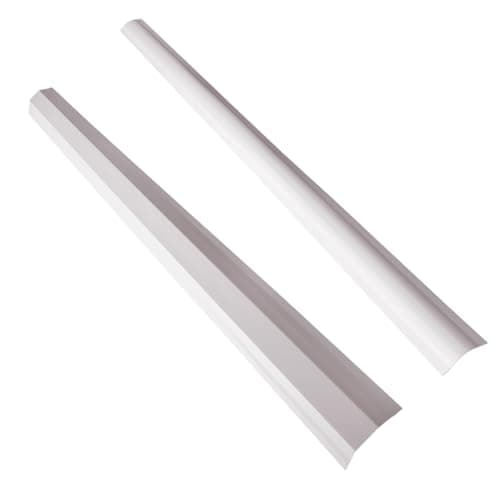 Cardinal Gates PinchNot CSP29 Door Shield (front and rear) A pair of shields that close the hinge-edge gap on the front and the rear of the door. It is the most expensive pick here and does one door, and it is still the only one addressing the severe injury on both sides. | Best overall: the only one that covers both hinge faces | 9.2 / 10 | $39.95Amazon |
| 02 | 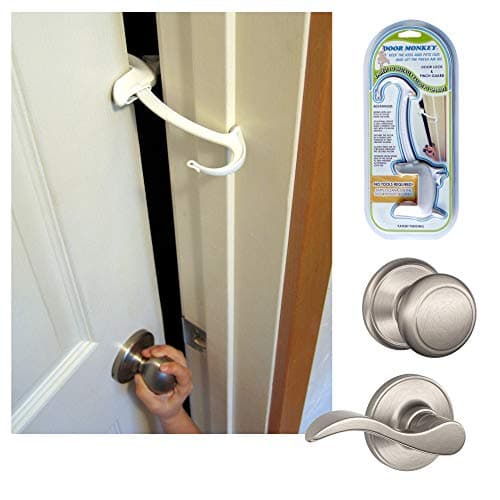 Door Monkey Child Proof Door Lock & Pinch Guard (DM1PKRTC) A clamp that holds the door locked in a cracked position: a door lock and a pinch guard in one. Standard 1 3/8 in doors with rectangular stop molding only. | Best if the door also needs to stay shut | 9.2 / 10 | $14.99Amazon |
| 03 | 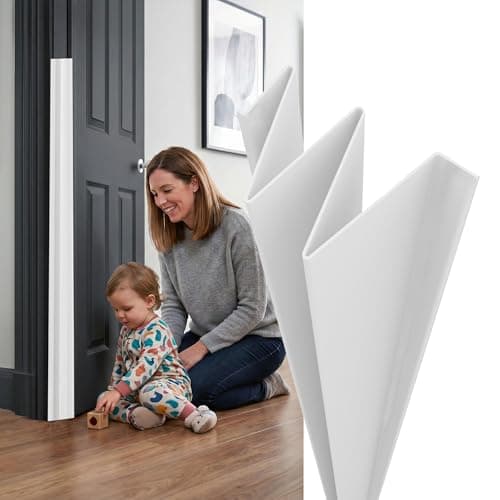 Fingersafe Push Side Door Hinge Finger Guard (43 in) An accordion strip that stretches across the hinge gap as the door opens, for a fraction of the two-face set. Push side only, so half the hinge edge stays open. | Best cheap hinge-side cover | 9.2 / 10 | $24.99Amazon |
| 04 | 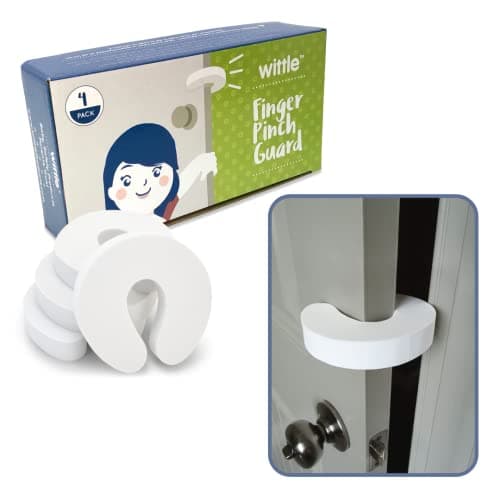 Wittle Finger Pinch Guard Door Stopper (4 pack) The latch-side foam C-clip whose maker claims it grips tightly enough not to slide off. Four per pack, and it only addresses the slam. | Best foam clip for grip | 9.2 / 10 | $9.99Amazon |
| 05 | 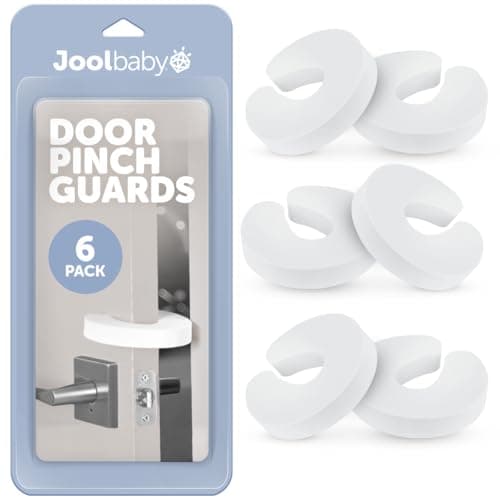 Jool Baby Door Pinch Guards (6 pack) Six EVA foam clips for roughly the price of one branded guard. The cheapest way to stop every door in a small house slamming, and nothing more than that. | Best value: six doors in one order | 9.0 / 10 | $9.99Amazon |
| 06 | 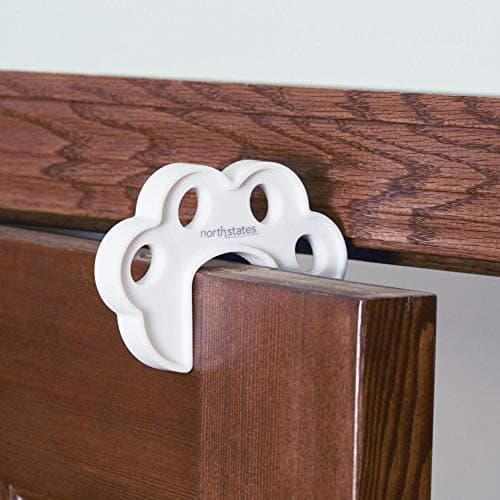 Toddleroo by North States Premium Pinch Protector (6144) Softer and thicker than the generic clips, from a brand that also makes certified gates - but it is one guard for roughly what a six-pack costs. | Best single guard to travel with | 8.8 / 10 | $8.65Amazon |
#ad · Prices come live from Amazon, last checked November 4, 2026. Scores are ours, on our published 8.4-9.8 recommendation scale, compiled from standards statements, manuals and specs. Nothing below 8.4 is listed. Tap a row for the full write-up.
The two gaps, and the one that matters
A closing door has two places a small hand can be, and they are not the same hazard. Almost everything sold as a "pinch guard" addresses the easier one.
The latch side. This is the edge with the handle, and the gap a toddler reaches into when the door is nearly shut. It closes with the door's own momentum - a draft, a sibling, a gust from an air conditioner - and the typical injury is a crushed fingertip, a bruised nail bed, a lot of screaming and, often, nothing broken. A foam clip over this edge holds the door off its latch so the gap never closes. That is a real fix for a real problem, and it costs a few dollars.
The hinge side. This is the opposite edge, and it is the dangerous one, because it behaves like a pair of scissors rather than a slamming lid. As the door opens, a wedge-shaped gap appears between the door and the jamb on one face, and a second gap opens around the hinge barrels on the other. Both of them close to nothing - no stop, no cushion, no handle to slow the door down - and the leverage at the hinge is enormous, because the door is a long lever pivoting a couple of inches from the knuckles. This is the gap that degloves a fingertip or takes it off.
The practical consequence is simple and it is the reason this page exists: buying a bag of foam clips and considering the door handled is a mistake. The clips are genuinely useful and they do not touch the injury you are most afraid of. Only two products on this page go near the hinge edge at all.
What the injury data says
Finger amputations in American emergency departments were counted in a decade-long review of national surveillance data: an estimated 234,304 visits between 2010 and 2019. The age distribution has two peaks, and the first of them is children aged 0 to 4, where doors are the predominant mechanism. That is not a soft number about bruises. It is the amputation count, and the youngest group in it is the group that sits on the floor beside a door that an adult is about to close.
It also tells you where the money should go. The CPSC's own childproofing guidance lists doorknob covers and door locks among its twelve devices, and those are about keeping a child out of the bathroom or the garage - a different hazard, covered in best door locks and knob covers. Nothing in the standard advice tells you about the hinge gap, which is why most parents meet it the hard way.
Two more things worth knowing before you shop. First, there is no consumer safety standard for this product category: no ASTM specification, no CPSC rule, no certification mark. Every pick on this page scores a 2 or a 3 on standards for that reason, and a listing claiming to be "certified safe" is claiming nothing. Second, this is a window of time, not a permanent install. The risk peaks when a child is tall enough to put a hand on a door edge and too young to understand what the door is about to do, which is roughly nine months to three years.
How we ranked these
The published rubric is on how we choose, and this page leans it hard toward one metric. We weight toddler resistance at 35 percent - far above the site default - and on this page we score that metric as the share of the pinch hazard the design actually removes. A shield that closes both hinge faces scores a 10. A clip that stops the latch-side slam and leaves the hinge gap untouched scores a 4, no matter how well made it is, and that is the per-page override you will see on the three foam clips. Value is held down to 15 percent, because when the failure mode is a fingertip, the cheapest product is not automatically the best buy.
Standards sit at 10 percent only because there is nothing to measure: no product here states a specification. Installation truth and adult usability carry 15 percent each - a guard that an adult removes every evening to close the door is a guard that spends half its life on the doorknob - and damage and reversibility 10 percent, which is where the adhesive shields give something back to the no-tape clips.
What we did not do is test any of these. We do not test products. Every spec on this page is quoted from the manufacturer page or the live retailer listing, linked beside it, and every pick was confirmed in stock on the day we checked.
Which guard for which door
You do not need one product. You need the right product for a specific door, and most houses have three or four doors that matter and a dozen that do not.
The door your child actually plays at. Usually one: the one between the kitchen and the hall, or the bedroom door that gets pushed back and forth all day. This is where the hinge-side shield goes, because it is the door the child is at when nobody is watching the door.
A door that must stay shut. The bathroom, the laundry room, the stairs. Here the pinch problem and the access problem are the same problem, and the Door Monkey solves both: it clamps to the door edge and holds it locked in a cracked-open position, so the child cannot push through and the door cannot swing shut on a hand. Check the fit first - it needs a standard 1 3/8 inch door with rectangular stop molding, which rules out a lot of older houses and anything with ranch-profile trim.
Every other interior door. Foam clips, bought by the half-dozen. Bedroom doors, closets, the spare room: doors a child passes rather than plays at, where the realistic hazard is a slam in a draft. One multipack covers the lot.
The doors that lead outside. A pinch guard is the wrong product. A door to a garage, a pool deck or a stairwell needs a lock or an alarm, which is how to childproof the garage and how to childproof a pool, not a strip of foam that holds the door open.
Placement: height is the whole game
Every maker of a foam clip says the same thing in its instructions and almost nobody reads it: put the guard high.
Wittle tells you to fit it high enough on the door edge to be out of a child's reach, or on the top edge at least six inches in from the corner. Jool says the same - any height on the edge, or the top of the door, to keep it away from the child. Toddleroo's instruction is the top or the outer edge. The reason is obvious once you have watched it happen: a soft foam clip at toddler height is a toy. It gets pulled off, chewed, hidden under the sofa, and the door it was protecting now slams freely while everyone assumes it is guarded.
The top edge is better than the side edge for a second reason. On the side, the clip sits in the gap the door closes into, so the door cannot latch and the room has no privacy; on the top, the door rests against the frame head with a small gap and most people find it less annoying, which means the guard stays on.
The hinge-side shields are a different job. They are adhesive, they go on once, and they stay. Clean the door with isopropyl alcohol rather than a kitchen spray - silicone in household cleaner is what kills adhesive tape - let it dry, and dry-fit the shield against the closed door before you peel the backing. A 43-inch strip gives you one attempt at alignment.
One more rule that costs nothing: slow the door down. A door that cannot slam cannot crush anything. If a door in a drafty hallway blows shut on its own, the cheap fixes are a floor wedge, a felt pad on the latch, or simply hooking the door open. The products on this page are for the doors where that is not practical.
The two hinge-side shields, side by side
These are the only two picks that address the hinge gap, and they are not substitutes for each other. The PinchNot set covers both faces of the door and is sized by swing and thickness; the Fingersafe strip covers one face and comes in a single length. Here is what each maker publishes.
| Spec | Cardinal Gates PinchNot CSP29 Door Shield (front and rear) | Fingersafe Push Side Door Hinge Finger Guard (43 in) |
|---|---|---|
| Covers | Hinge-side gap on the front and the rear of the door | Push side of the hinge edge, 43 in length |
| Install | Peel and stick, no tools; adhesive stated to remove without scratches or residue | Pre-applied 3M adhesive, tool-free |
| Model | Not published | HOME-PARENT-01, white |
Read that first row again, because it is the whole decision. "Front and rear" means both sides of the door: the wedge gap that closes as the door shuts and the hinge-barrel gap behind it. "Push side" means one. If the door is in a hallway and your child plays on both sides of it - which is what children do with a door - a single-face strip leaves the other gap exactly as it was.
The second decision is sizing, and only Cardinal Gates publishes a rule. CSP29 is the 90-degree set for a door under 1 3/8 inches thick; CSP30 is the 180-degree set, and also the one for a door between 1 3/8 and 2 inches; CSP40 is for anything over 2 inches or a commercial door. Go and open the door before you order: if it swings flat back against the wall it is a 180-degree door, and the 90-degree shield will foul the frame. Fingersafe publishes no thickness guidance at all, only that its pleated cover allows 180-degree rotation.
What does not work
Four things people try, in rough order of how often we see them recommended.
A towel over the door. It stops the latch and it falls off. It also hangs at exactly toddler height, which makes it a pull toy on a door.
Corner guards or edge foam on the door edge. Adhesive edge foam is made for the corner of a coffee table and it is covered in best corner guards. On a door edge it compresses to nothing under the door's leverage, and it is in the one place a bored child can pick at it all day.
A knob cover instead. A knob cover stops the door being opened. It has no effect on a door being closed, which is the pinch hazard. Both can be useful on the same door; neither replaces the other.
Nothing, because the doors are soft-close. Soft-close hinges and door closers are a genuine improvement on the slam and change nothing at the hinge edge. The gap is a function of the geometry of a hinged door, not its speed.
And one that does work, free: close doors with your hand on the edge, not the handle, while there is a baby in the house. You will feel a hand before you crush it. Every parent who has done this for a year does it forever.
In detail
Every pick, in full
01
Best overall: the only one that covers both hinge faces
Cardinal Gates PinchNot CSP29 Door Shield (front and rear)
Our score
9.2 / 10Prevents
A pair of shields that close the hinge-edge gap on the front and the rear of the door. It is the most expensive pick here and does one door, and it is still the only one addressing the severe injury on both sides.
- Standards status
- No standard stated on the listing
- Installation truth
- You have to size it before you order, and the rule is the door's swing and thickness, not its width: CSP29 is for a door that opens to 90 degrees and is under 1 3/8 in thick, CSP30 for 180 degrees or 1 3/8 to 2 in, CSP40 for anything over 2 in or a commercial door. Buy the wrong one and the shield fouls the frame. It is adhesive, so the surface has to be clean, and it stays on the door permanently - this is not the guard you move around the house.
Published specs (tap for source)
Rubric sub-scores (0-10) and this page's weights
- Standards & certification (10%)
- 3
- Installation truth (15%)
- 8
- Toddler resistance (35%)
- 10
- Adult one-hand use (15%)
- 9
- Damage & reversibility (10%)
- 7
- Value (15%)
- 5
What it gets right
- Covers the hinge side, which almost nothing else does
- Front and rear in one set
- No tools, no screws
- Sized properly for 90 and 180 degree doors and for commercial thickness
What it doesn't
- The most expensive thing in this category by a wide margin, and it does one door
- You must know your door's swing and thickness before ordering
- Adhesive, and it lives on the door permanently
- No standards statement
Skip it if…
…you do not know whether your door opens to 90 or 180 degrees; measure first, because the wrong set does not fit.
#ad · Price as of November 4, 2026 · Affiliate disclosure for the link to Cardinal Gates PinchNot CSP29 Door Shield (front and rear)
02
Best if the door also needs to stay shut
Door Monkey Child Proof Door Lock & Pinch Guard (DM1PKRTC)
Our score
9.2 / 10Prevents
A clamp that holds the door locked in a cracked position: a door lock and a pinch guard in one. Standard 1 3/8 in doors with rectangular stop molding only.
- Standards status
- No standard stated on the Door Monkey product page
- Installation truth
- It only fits standard 1 3/8 in interior doors with rectangular door-stop molding, which Door Monkey states on the listing in as many words. Rounded or ranch-profile stop molding, a thicker slab or a door with no stop will not hold it. It clamps on with no tape and no tools, which also means a determined four-year-old can take it off - this is a toddler device.
Published specs (tap for source)
Rubric sub-scores (0-10) and this page's weights
- Standards & certification (10%)
- 3
- Installation truth (15%)
- 8
- Toddler resistance (35%)
- 7
- Adult one-hand use (15%)
- 9
- Damage & reversibility (10%)
- 10
- Value (15%)
- 7
What it gets right
- Two jobs in one: it keeps the child out and keeps the door off their fingers
- No tape and no screws, so nothing marks the door
- Works from both sides, so no accidental lock-ins
- Height is adjustable on the door edge
What it doesn't
- Will not fit a non-standard door or rounded stop molding
- Holds the door ajar, so the room has no privacy while it is on
- One door per unit
- Does nothing about the hinge-side gap
Skip it if…
…your interior doors are thicker than 1 3/8 in or the stop molding is rounded; the clamp has nothing square to grip.
#ad · Price as of November 4, 2026 · Affiliate disclosure for the link to Door Monkey Child Proof Door Lock & Pinch Guard (DM1PKRTC)
03
Best cheap hinge-side cover
Fingersafe Push Side Door Hinge Finger Guard (43 in)
Our score
9.2 / 10Prevents
An accordion strip that stretches across the hinge gap as the door opens, for a fraction of the two-face set. Push side only, so half the hinge edge stays open.
- Standards status
- No standard stated on the listing
- Installation truth
- This is the push side only - the face the door swings away from. The pull-side gap, the one that closes as the door shuts, is left open, so on a door a child plays both sides of you need this plus a latch-side guard, or the two-face set instead. Pre-applied 3M adhesive means a clean door surface and no second attempt.
Published specs (tap for source)
Rubric sub-scores (0-10) and this page's weights
- Standards & certification (10%)
- 2
- Installation truth (15%)
- 8
- Toddler resistance (35%)
- 8
- Adult one-hand use (15%)
- 8
- Damage & reversibility (10%)
- 6
- Value (15%)
- 6
What it gets right
- Addresses the hinge gap, not just the slam
- One length fits most interior doors
- Low profile and white, so it reads as trim
- No tools
What it doesn't
- One face only, so half the hinge edge stays exposed
- Adhesive, and a 43 in strip gives you one chance to line it up
- No door-thickness or swing guidance published
- The listing is the only source of specs
Skip it if…
…the child uses both sides of the door; a single-face strip leaves the other gap wide open.
#ad · Price as of November 4, 2026 · Affiliate disclosure for the link to Fingersafe Push Side Door Hinge Finger Guard (43 in)
04
Best foam clip for grip
Wittle Finger Pinch Guard Door Stopper (4 pack)
Our score
9.2 / 10Prevents
The latch-side foam C-clip whose maker claims it grips tightly enough not to slide off. Four per pack, and it only addresses the slam.
- Standards status
- No standard stated on the listing
- Installation truth
- Wittle's own instruction is the important one: put it high enough up the door edge to be out of a child's reach, or on the top of the door at least six inches in from the edge. It comes off in a second, which means it also comes off when you close the door for privacy. Put it back, or hang it on the handle where you will see it.
Published specs (tap for source)
Rubric sub-scores (0-10) and this page's weights
- Standards & certification (10%)
- 3
- Installation truth (15%)
- 9
- Toddler resistance (35%)
- 4
- Adult one-hand use (15%)
- 9
- Damage & reversibility (10%)
- 10
- Value (15%)
- 9
What it gets right
- No install
- Grips tightly rather than hanging loose
- Keeps children and pets from being shut in a room
- White, so it disappears on most doors
What it doesn't
- Door cannot close while it is on
- Four per pack rather than six
- Easy to lose
Skip it if…
…you need the door to close; this is a stop, not a lock.
#ad · Price as of November 4, 2026 · Affiliate disclosure for the link to Wittle Finger Pinch Guard Door Stopper (4 pack)
05
Best value: six doors in one order
Jool Baby Door Pinch Guards (6 pack)
Our score
9.0 / 10Prevents
Six EVA foam clips for roughly the price of one branded guard. The cheapest way to stop every door in a small house slamming, and nothing more than that.
- Standards status
- No standard stated on the Jool Baby product page
- Installation truth
- Jool's own instruction is the one that matters: put it high on the door edge, or on the top of the door, so it is out of a child's reach - a guard at toddler height is a toy. They slip off as easily as they slip on, which is the trade for no adhesive: the guard a parent took off to close the door at 8pm is the guard that is not protecting anything at 7am.
Published specs (tap for source)
Rubric sub-scores (0-10) and this page's weights
- Standards & certification (10%)
- 2
- Installation truth (15%)
- 10
- Toddler resistance (35%)
- 4
- Adult one-hand use (15%)
- 7
- Damage & reversibility (10%)
- 10
- Value (15%)
- 10
What it gets right
- Six guards, so cost per door is the lowest here
- No adhesive, no tools, nothing to damage
- Also stops a pet being shut in a room
- Light enough to hang on the handle when not in use
What it doesn't
- Slips off as easily as on
- Latch side only - the hinge gap is untouched
- No dimensions published
- Door will not fully close while fitted
Skip it if…
…you need the door to latch; a foam clip is a stop, not a lock.
#ad · Price as of November 4, 2026 · Affiliate disclosure for the link to Jool Baby Door Pinch Guards (6 pack)
06
Best single guard to travel with
Toddleroo by North States Premium Pinch Protector (6144)
Our score
8.8 / 10Prevents
Softer and thicker than the generic clips, from a brand that also makes certified gates - but it is one guard for roughly what a six-pack costs.
- Standards status
- No standard stated on the listing
- Installation truth
- It is one guard, not a pack, and at this price a six-pack of plain foam clips costs less. North States does not publish a door-thickness range for it, only that it fits nearly all standard interior doors. Like every clip of this kind, the door cannot be fully closed while it is fitted, so it comes off at bedtime and that is when it gets lost.
Published specs (tap for source)
Rubric sub-scores (0-10) and this page's weights
- Standards & certification (10%)
- 3
- Installation truth (15%)
- 10
- Toddler resistance (35%)
- 4
- Adult one-hand use (15%)
- 8
- Damage & reversibility (10%)
- 10
- Value (15%)
- 4
What it gets right
- Softer and thicker than the generic foam clips
- Clips on the top edge, which keeps it out of reach
- Portable - it is the one to throw in a travel bag
- A brand that also makes gates to a stated standard
What it doesn't
- One guard for roughly the price of a six-pack
- No published door-thickness range
- Door cannot close while it is on
- Latch side only
Skip it if…
…you need to cover more than one door; buy a multipack instead.
#ad · Price as of November 4, 2026 · Affiliate disclosure for the link to Toddleroo by North States Premium Pinch Protector (6144)
Buying notes
Measure the door, not the doorway. Two numbers decide which hinge-side shield fits: how far the door swings (90 degrees, or flat back against the wall at 180) and how thick the slab is. A tape measure on the edge of the open door takes ten seconds and is the difference between a shield that fits and a return.
Buy the multipack, not the single. In the foam-clip tier, a six-pack costs about what one branded single guard costs. Unless you want the thicker Toddleroo clip specifically for a travel bag, the arithmetic is not close.
Expect to lose them. Foam clips come off every time an adult wants the door shut, and then they live on the doorknob or they live nowhere. Buy more than you have doors, and hang them on the handle rather than putting them on a shelf.
Check the stop molding before you buy a clamp. The Door Monkey needs a standard 1 3/8 inch door and square, rectangular door-stop molding. Run a finger down the trim in your doorway: if the profile is rounded, the clamp has nothing to grip, and no amount of adjusting will fix it.
Do not pay for a certification claim. Nothing in this category has a standard behind it. Gates do - 16 CFR part 1239 and ASTM F1004, which is covered in baby gate safety standards explained - and window guards do, in best window guards and locks. Pinch guards do not. Judge them on the gap they cover and on whether their maker will tell you what fits.
Where this sits in the job. Door pinch guards are a cheap, late item on the list: well behind anchoring furniture and gating stairs, roughly level with corner guards. The full order is in the babyproofing checklist, and the room this hub covers is in how to childproof windows.
How we chose
How these picks were chosen
Every product currently sold for this job was read and compared, then scored against the exact problem this page is about: the manufacturer's published specs, the opening and fit charts, the safety standard it states, the install conditions in the manual, the warranty terms and the cited research. The sources are listed at the bottom of the page.
Scores come from that published data on a rubric you can read, a missing spec is scored neutral rather than guessed, and nobody pays for placement. The full rubric is on How We Choose.
- Standards & certification
- 10%
- Installation truth
- 15%
- Toddler resistance
- 35%
- Adult one-hand use
- 15%
- Damage & reversibility
- 10%
- Value
- 15%
The weights that ordered this page. Each product's score is published on our 8.4-9.8 recommendation scale and is the same wherever it appears.
FAQ
Questions people ask
Which side of the door hurts children more, the handle side or the hinge side?
Do foam door pinch guards actually work?
Is there a safety standard for door pinch guards?
What size PinchNot do I need?
Will an adhesive hinge guard damage a painted door?
How long do we need pinch guards on the doors?
Keep going
Related guides and picks
- Best door locks and knob coversThe other door problem: keeping a child from opening it in the first place.
- Best corner guardsThe same cheap-foam tier, for the hazard foam is actually made for.
- The babyproofing checklistWhere pinch guards sit relative to anchors, gates and outlets.
- Babyproofing for a 1 year oldThe stage when hands start finding door edges.
Update log
What changed
- First published.
Receipts
Sources
- 01Traumatic Finger Amputations: Epidemiology and Mechanism of Injury, 2010-2019 (PubMed record 36154498): an estimated 234,304 US emergency department visits for finger amputations over the decade, with the first age peak at 0 to 4 years and doors the predominant mechanism in that group (checked Oct 15, 2026)
- 02CPSC publication: Childproofing Your Home, 12 Safety Devices to Protect Your Children (accessed Sep 21, 2026)
- 03Children's Hospital Colorado: Home baby proofing room by room (accessed Sep 21, 2026)
Specs, standards statements and install requirements come from the manufacturer's own pages and manuals (or a named retailer's listing where the brand doesn't publish them); injury data and standards come from the CPSC, ASTM, NEC via ESFI and the AAP, linked above. Prices are set by Amazon and change often, so the buy button always takes you to the live listing. Read the full method.