03 Furniture Anchors & Tip-Over Guide
What furniture needs to be anchored: the test is whether a drawer turns it into a ladder, not how heavy it is
Weight is not the variable. A child climbing an open drawer applies leverage at the worst possible point, which is why a 40-pound chest tips and a 300-pound sideboard does not.
- By
- Mike M.
- Updated
- Method
- How we choose
We earn a commission if you buy through our links, at no extra cost to you. It never decides the ranking: the method is published. Affiliate disclosure
The test: can a child climb it
A tip-over is a leverage problem. A piece of furniture stays upright while its centre of gravity sits behind the front feet. Open a drawer and the mass moves forward. Put a 25-pound toddler on that open drawer, two feet out from the carcass, and the moment arm is enormous compared with the weight of the piece resisting it. That is why the CPSC's tip-over reporting is dominated by chests, dressers and televisions rather than by the heaviest furniture in the house.
So the three questions to ask about any piece are: does it have drawers or shelves a child can get a foot on; is it taller than it is deep; and is there anything on top worth climbing for. A yes to the first is usually enough on its own. A yes to all three makes it a priority rather than a to-do.
One counter-intuitive consequence: cheap furniture is more dangerous than expensive furniture of the same shape, because particleboard carcasses are light, and the lighter the piece the less it resists the moment a climbing child creates.
The room-by-room list
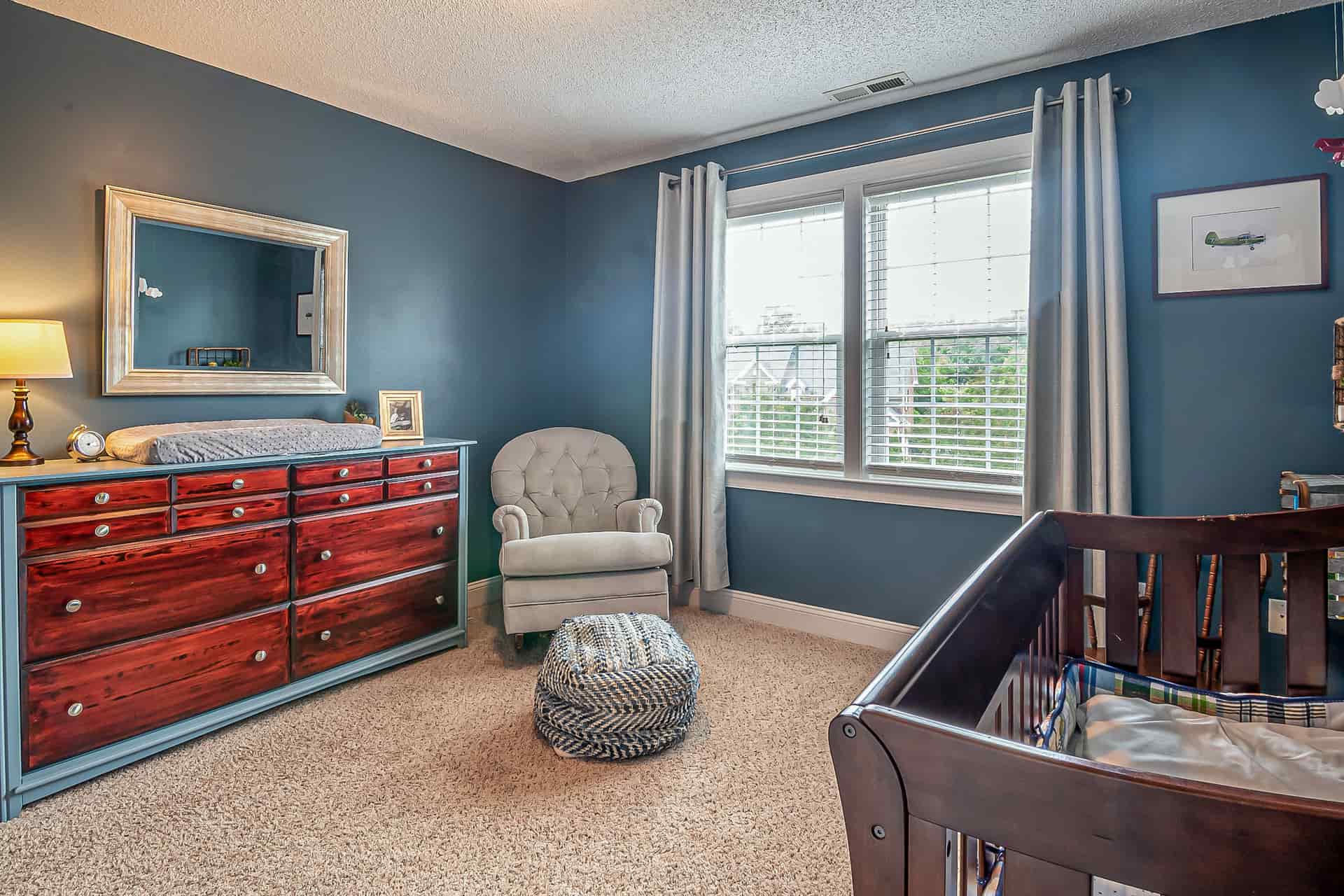
Child's bedroom and nursery. The dresser, always - this is the single most important anchor in the house, because it is in the room where a child is unsupervised the most. The changing table if it is a separate unit. The bookcase. The wardrobe. Any toy storage unit with shelves.
Living room. The television, strapped to the wall or to the stand, and then the stand strapped to the wall. Doing only the first half is the mistake: the CPSC's own recommendation is TV to furniture and furniture to wall, because a TV bolted to a stand that tips just travels with it. Then the media unit, any shelving, and a tall lamp if a crawler can pull it over.
Main bedroom. Your own dresser and wardrobe, which people skip because a child "is never in there alone". They will be.
Kitchen and utility. The range, if it has a factory anti-tip bracket - a huge share were never installed, and an oven door that a child stands on is a tip-over with a hot cavity attached. Tall pantry units and any free-standing shelving.
Hallways and the rest. Console tables, hall trees, shoe racks with shelves, and the bookcases that end up on landings, which is the worst possible place for one.
What does not need anchoring
Being honest about this matters, because a list that says "everything" gets ignored. Four categories genuinely do not need a strap.
Built-in furniture already fixed to the structure. Low, wide pieces with no climbable feature - a blanket chest, a wide low sideboard with doors rather than drawers, a solid coffee table. Furniture heavy and deep enough that a child's weight cannot move the centre of gravity past the front feet, which in practice means solid-wood pieces deeper than they are tall. And upholstered seating, with the exception of anything a child can use as a launch pad into a window or over a stair rail.
The edge case is a short, heavy dresser, and the honest answer is that we would still anchor it: it costs fifteen dollars and five minutes, and the drawer test applies whatever the height. The longer argument is on do you really need to anchor furniture.
What STURDY changed, and what it did not
In 2023 the CPSC adopted ASTM F2057-23 as a mandatory standard for clothing storage units, under the STURDY Act. New dressers sold in the US now have to pass stability testing that simulates a climbing child, which is a genuine improvement and the reason a new dresser is a better starting point than an old one.
Three things it does not do. It does not cover bookcases, media units, shelving or televisions, which are outside the definition of a clothing storage unit. It does not apply to the furniture already in your house. And it does not mean a compliant dresser cannot tip - the standard raises the bar it has to clear, while the anchor is still what the manufacturer tells you to fit. If your dresser came with a restraint kit in the bag of fittings, that kit is part of the product, not an accessory.
What to buy for each type
Three product shapes cover the whole list: a steel bracket-and-cable kit for heavy pieces, a woven strap set for the many light ones, and a TV-specific strap that can also tie the stand to the wall. The no-drill option is last, and honestly labelled.
If you can only do three pieces
Do the dresser in the child's room, the television, and the tallest bookcase in the room where the child plays. That order follows the injury reporting rather than the room layout, and it takes about forty minutes with a stud finder.
Then work outward on the list above as time allows. The practical walkthroughs are on how to anchor a dresser, how to anchor a TV and how to anchor a bookshelf; the wall-type problem is on furniture anchors for drywall, plaster and brick; and if you cannot drill at all, read anchoring furniture in a rental before buying an adhesive strap.
One piece deserves its own page, because the install is different and the frame gives you almost nothing to screw into: a tall leaning floor mirror. Best anti-tip kits for mirrors covers where the screw goes.
How we chose
How these picks were chosen
Every product currently sold for this job was read and compared, then scored against the exact problem this page is about: the manufacturer's published specs, the opening and fit charts, the safety standard it states, the install conditions in the manual, the warranty terms and the cited research. The sources are listed at the bottom of the page.
Scores come from that published data on a rubric you can read, a missing spec is scored neutral rather than guessed, and nobody pays for placement. The full rubric is on How We Choose.
- Standards & certification
- 30%
- Installation truth
- 30%
- Toddler resistance
- 20%
- Adult one-hand use
- 5%
- Damage & reversibility
- 5%
- Value
- 10%
The weights that ordered this page. Each product's score is published on our 8.4-9.8 recommendation scale and is the same wherever it appears.
FAQ
Questions people ask
What furniture needs to be anchored to the wall?
Do short dressers need to be anchored?
Does a TV need anchoring if it is on a stand?
Does IKEA furniture come with anchors?
What furniture does not need to be anchored?
Keep going
Related guides and picks
- Do you really need to anchor furnitureThe numbers behind the list, and the honest exceptions.
- Best furniture anchorsThe ranked anchors once you know which pieces you are doing.
- How to anchor a dresserThe first piece on the list, step by step.
- Best TV anti-tip strapsThe television, which no furniture strap set covers properly.
Update log
What changed
- First published.
Receipts
Sources
- 01CPSC news release, Feb 8, 2024: TV and furniture tip-over fatalities and injuries (accessed Sep 21, 2026)
- 02CPSC: 2023 Annual Tip-Over Report, PDF (accessed Sep 21, 2026)
- 03CPSC news release, 2023: CPSC adopts ASTM F2057-23 (STURDY) as a mandatory standard for clothing storage units (accessed Sep 21, 2026)
- 04CPSC Anchor It! campaign (accessed Sep 21, 2026)
Specs, standards statements and install requirements come from the manufacturer's own pages and manuals (or a named retailer's listing where the brand doesn't publish them); injury data and standards come from the CPSC, ASTM, NEC via ESFI and the AAP, linked above. Prices are set by Amazon and change often, so the buy button always takes you to the live listing. Read the full method.